
It’s never too late to make a career change. That’s the lesson that countless people have learned, as it’s easier than ever to develop new skills online through short, job-focused certificate programs to move into steadier, higher-paying work.
Take Google’s Career Certificates, for example. More than one million people have completed these courses (among them, more than 350,000 Americans), and over 70% said they found a new job, got promoted, or received a raise within six months.1,2 And Coursera’s Learner Outcomes Reports back this up: in the 2025 edition, 91% of learners said their studies led to a real career benefit, with nearly half of learners reporting salary increases.3, Thirty-seven percent of these students were 35 years or older at the time of taking a course on the platform.
What this really shows is that breaking into tech has less to do with age or experience and more to do with access to the right kind of training. Coursera partners with major players like Google, IBM, Meta, and Salesforce to teach practical skills in areas such as data analytics, cybersecurity, UX design, and IT support. And since these courses cost a fraction of what a degree would, they’ve become a lifeline for career changers looking for something new without starting from scratch.
Before we take a look at some of the Coursera Professional Certificates that can lead to a career change into tech, let’s first see why career changes are on the rise right now and where the strongest growth lies.
Why career changes are on the rise in 2025
More and more people are considering a jump into tech in 2025. Whether it’s AI disruption, difficulties finding work in your chosen field, or just a need to try something new, tech remains one of the fastest-growing and most exciting fields today.4
CompTIA’s latest State of the Tech Workforce report puts U.S. tech occupation employment at about 6.1 million in 2024.5 That’s roughly 72,500 more jobs than the year before, a reminder of how steady the field’s growth has been. What’s more, nearly half of job postings no longer list a four-year degree requirement in an attempt to expand the candidate pool and fill tech staffing needs.6 This skills-based approach to hiring has been in place for several months. It doesn’t show any signs of slowing down, widening opportunities for people entering tech from other fields, such as retail or administrative work.
Where the biggest growth is in tech in 2025
Tech is not one narrow field, but a mix of analytical, creative, and management roles that all depend on digital tools, so professionals who want to switch to tech careers should pay attention to where growth really is across tech.
And although tech-aligned occupations are expected to grow much faster than the national average of 3% through 2034, that doesn’t mean growth will be equal in all tech careers.7
Here are some of the tech positions expected to see big growth over the next decade:
- Data scientists are projected to grow by 34%8
- Information security analysts are projected to grow by 29%9
- Operations research analysts are projected to grow by 21%10
- Software developers are projected to grow by 15%11
Many of the above jobs rely heavily on coding, but there are options for people not interested in that kind of work. Outside of the traditional programming track, CompTIA’s State of the Tech Workforce 2025 also identifies strong demand for roles in tech support, IT project management, and more.5
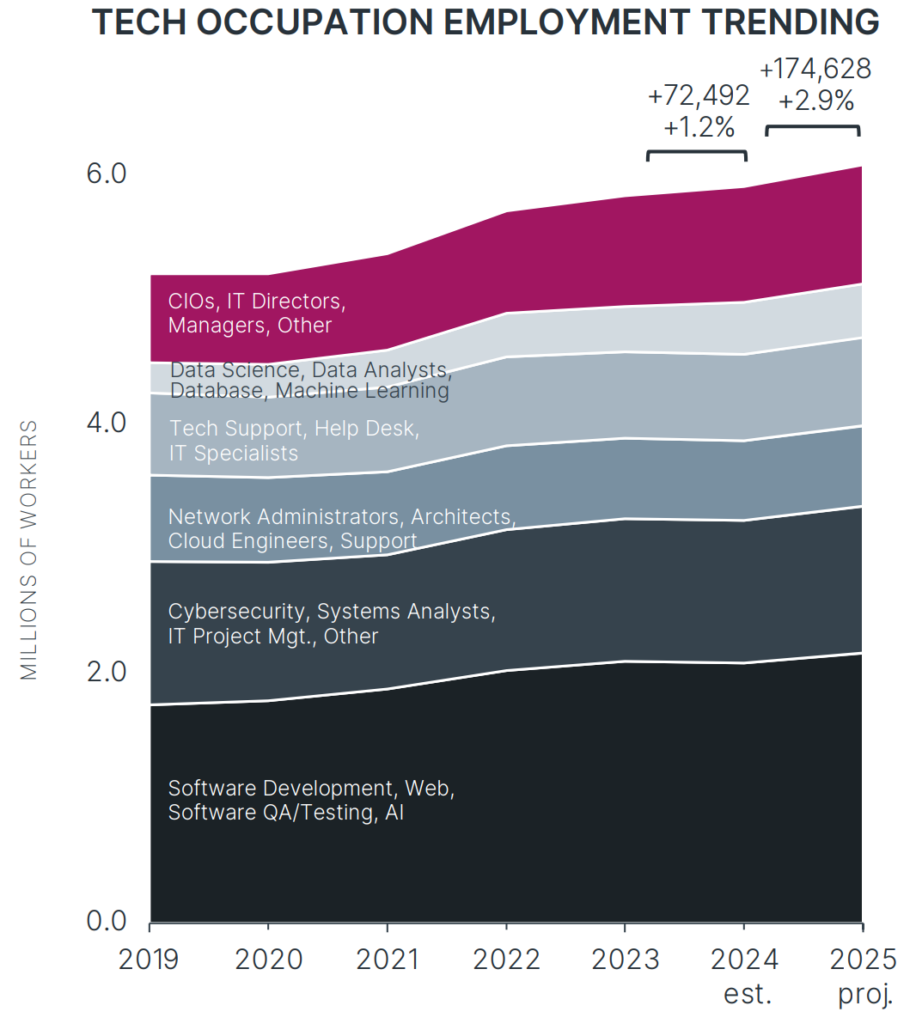
State of the Tech Workforce 2025, CompTIA5
Another major area of growth is in the fields of AI and machine learning. As automation and digital transformation progress, more and more jobs in traditional fields will require these skills. In fact, according to the World Economic Forum, close to 60% of all businesses will transform due to these new technologies by 2030, with new openings and hybrid roles that will need these new skills, plus existing business experience.12
All of this is good news for mid-career professionals who are willing to learn new skills to complement their existing experience. For instance, if you like working with numbers, you might move toward data analysis. If you’re more detail-driven and enjoy solving technical problems, cybersecurity or IT support could make sense instead. None of these paths requires starting from scratch; instead, they reward the skills many adults already have, paired with up-to-date technical training.
Why Coursera is the ideal platform for career changers
Adults who want to move into tech later in life often face three significant barriers: time, cost, and confidence. Coursera was built to remove all of those hurdles.
Time, for instance, stops being an obstacle when learning fits around your life. Coursera Professional Certificates are self-paced and flexible, and most are designed to wrap up in six months or less if you study about 10 hours a week.13
Coursera is also incredibly affordable, especially when compared to getting a four-year degree. Instead of paying for each course, learners can subscribe monthly. Coursera Plus is $49 a month, or $399 a year, which brings the cost down to roughly $33 a month.14 Since you can take multiple Coursera courses for beginners in tech all at once, the savings multiply fast. Even with only one course at a time, it is still just a fraction of what a traditional degree would cost.
The biggest advantage of Coursera is its partners. Its tech pathways are created with industry leaders like Google, IBM, Meta, and Salesforce, along with top universities like Duke and Imperial College London, shaping each course around real-world hiring needs.15
Coursera doesn’t leave learners to figure out the next step alone either. Career tools are built right into the platform, from portfolio-building guidance to interview practice.16 And did you know about the Grow with Google Employer Consortium? It’s a network of over 150 companies that hire Google Career Certificate graduates.17 This kind of structured support helps rebuild confidence in adults after years away from formal education or job hunting.
Spotlight: Coursera certificates for tech career starters
Coursera Professional Certificates offer focused, beginner-friendly tech courses that build real workplace skills for anyone taking a first step into tech. Let’s look at some of the best Coursera certificates for career changers, one field at a time.
Data Analytics
Data science is one of the fastest-growing fields in tech, with 34% growth projected between 2024 and 2034. Plus, people in this field are well paid, with the 2024 median pay being $112,590 per year, or about $54 an hour.8
For people interested in a career in data science, Coursera offers programs like:
- The Google Data Analytics Professional Certificate teaches skills linked to entry-level analyst roles, like spreadsheet analysis, SQL, Tableau, and data-driven storytelling.18 It’s built for learners who are comfortable with numbers but new to coding.
- The IBM Data Analyst Professional Certificate goes further into Python, Excel automation, and visualization tools such as Cognos Analytics, giving learners a technical edge for jobs involving dashboards or reporting.19
Cybersecurity
With a projected growth of 29%, information security analysts are the next on the BLS tech list. Their 2024 median pay sits at $124,910 per year, or $60 an hour.9
Coursera programs for cybersecurity include:
- The Google Cybersecurity Professional Certificate trains learners in network defense, risk assessment, and Security Information and Event Management (SIEM) tools.20 It requires no background in IT and prepares graduates for roles such as junior security analyst.
- The IBM Cybersecurity Analyst Professional Certificate focuses on incident response and operating systems, helping learners qualify for entry-level positions in monitoring and mitigating threats to networks and databases.21
Project Management
Project management specialists are another in-demand speciality, with a faster-than-average projected change in employment of 6% by 2034, earning roughly $48.50 per hour, or $100,750 a year.22
When it comes to project management, Coursera offers:
- The Google Project Management Professional Certificate suits people who are organized, communicative, and already used to coordinating tasks.23 It covers Agile and Scrum frameworks, scheduling, and stakeholder management, all key skills for business-side tech projects.
- The Microsoft Project Management: Build Job-Ready Skills Professional Certificate focuses on giving learners the skills they need to succeed in project management.24 This includes using Microsoft Excel for data analysis and visualization and learning all of the main concepts needed to pass the Project Management Professional (PMP) exam.
UX Design
Without a special BLS category dedicated to them, UX designers are included in their stats for web developers and digital designers. This group has a projected job growth of 7% and a median pay of $95,380 per year, or nearly $46 an hour.25
If you’re interested in starting a career in UX design, Coursera offers:

"Career Karma entered my life when I needed it most and quickly helped me match with a bootcamp. Two months after graduating, I found my dream job that aligned with my values and goals in life!"
Venus, Software Engineer at Rockbot
- The Google UX Design Certificate helps creative professionals and marketers learn user-research methods, wireframing, and prototyping with Figma.26 Graduates finish with a design portfolio ready for job applications.
- The Generative AI for UI UX Design Specialization from IBM specializes in giving students the skills they need to integrate AI into their UX design work.27
IT and Cloud Support
While the BLS expects a slight decline in demand for computer support specialists, about 50,000 openings are still projected each year, on average, over the next decade.28 The median earnings reported of around $29.50 per hour amount to $61,550 a year.
To get started in IT and cloud support, you could look into the following Coursera programs:
- The Google IT Support Professional Certificate introduces computer networks, operating systems, and troubleshooting.29 It’s the foundation for roles such as help-desk or technical-support specialist.
- AWS Cloud Practitioner Essentials explains core cloud concepts, pricing models, and security to learners interested in cloud computing, who are thinking of exploring DevOps or systems administration later on.30
AI and business transformation
There is no distinct “AI” occupation code to report on, but the prompt engineering market is estimated to grow by 32.8% every year by 2030.31 On top of that, AI skills are now spreading everywhere, permeating roles in a range of industries, with an advertised salary 28% higher on average than job postings that don’t mention them.32
For people interested in exploring AI, you can look at the following Coursera programs:
- The AI for Everyone course by DeepLearning.AI demystifies artificial intelligence for non-technical professionals. Having a basic knowledge of AI can go a long way in many careers in tech and beyond.33
- Duke University’s AI Product Management Specialization bridges business strategy with technical teams over the course of 4 months, helping managers guide AI projects responsibly and effectively.34
How to choose the right tech path
A career change works best when it builds on what you already do well. The skills you’ve used in other jobs can transfer directly into tech, but the key is finding the field that fits both your strengths and your interests.
| If you’re good at… | You might excel in… | Recommended Coursera program |
| – Planning – Coordinating – Motivating others | Project Management Ideal for detail-oriented people who enjoy organization and team leadership. | Google Project Management Certificate |
| – Working with data – Spotting patterns – Using spreadsheets or reports | Data Analytics Suited for analytical thinkers who like uncovering insights and trends. | Google Data Analytics Certificate or IBM Data Analyst Certificate |
| – Solving technical problems – Evaluating risks – Ensuring systems run safely | Cybersecurity A good fit for logical minds with patience and curiosity for how systems work. | Google Cybersecurity Certificate or IBM Cybersecurity Analyst Certificate |
| – Creating visuals – Improving user experiences – Understanding people’s needs | UX/UI Design Best for creative professionals and communicators who value empathy and storytelling. | Google UX Design Certificate Generative AI for UI UX Design Specialization |
| – Helping customers – Solving practical issues – Learning how tech systems connect | IT Support Great for patient, resourceful learners who enjoy helping others. | Google IT Support Certificate |
| – Bridging business and technology – Guiding innovation responsibly | AI & Business Transformation Ideal for leaders who want to understand how AI shapes decisions. | Duke University AI Product Management Specialization |
As you can see, switching paths doesn’t mean starting over, as every career leaves behind a toolkit of transferable skills. Coursera’s structure helps you put those skills to use, at your own pace and on your own terms.
Start by exploring Coursera’s Career Academy, where you can explore different careers, as well as preview course content, explore job titles linked to each certificate, and estimate completion time. Taking the time to match your personality and transferable skills with a clear learning path will help you stay motivated once you start.
Success stories: real people who pivoted to tech
Seeing others make the leap can make a career change feel more real. Coursera’s learners come from all kinds of backgrounds, and many have already built new careers in tech.
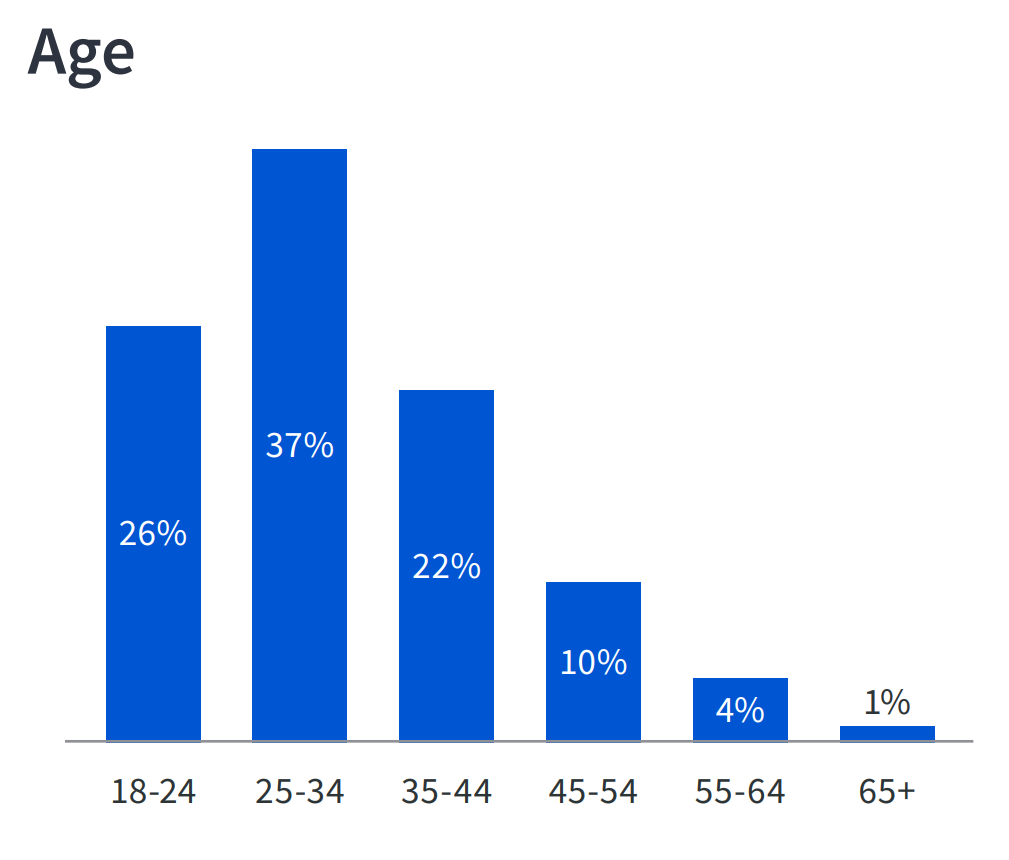
Coursera learners by age, 2025 Learner Outcomes Report3
After spending ten years as a stay-at-home mom, Adrienne decided it was time for a change.35 She enrolled in the Google Project Management Professional Certificate on Coursera and leveraged her practical experience in organizing family life into new project-coordination skills, landing a job at a top technology company.
Carlos left behind a career as a studio musician and felt ready for something new.36 He completed the Google IT Support Professional Certificate on Coursera despite having no formal tech background, and his certificate led to a job at Amazon as a Data Center Technician.
While expecting her first child and reflecting on her career in sales, Emma enrolled in the IBM Data Science Professional Certificate on Coursera.37 This helped her shift into a data-science track after a recruiter saw the credential on her LinkedIn profile.
These stories share a pattern: none of them started with tech knowledge and experience. By learning on Coursera, they could build new skills and step into roles that valued what they knew, proving that a career shift into tech isn’t limited by age or background. It is instead powered by access to the right training, with a dash of curiosity and persistence.
Overcoming fear and age bias
For many adults, the hardest part of changing careers is overcoming the fear. Many have concerns about age, competition, keeping up with technology, or not having enough time to pivot into a completely new field. But the data paints a different story.
An AARP survey found that 62% of workers over 50 want to expand their skill sets.38 They see professional development and training as key to staying employable. The easiest way to do it is by actively pursuing online training for a career change or simply to stay current. At the same time, many employers are also rethinking how they evaluate experience by creating no-degree tech jobs. This gradual move away from requiring degrees and favoring proven skills instead is a phenomenon that The Burning Glass Institute calls “downcredentialing” or “degree reset.”39
For mid-career professionals, that’s a major shift. Skills-based hiring means that years spent solving problems count, whether managing teams or supporting customers. They simply need to be paired with modern technical knowledge that can be supplemented through structured programs like Coursera Professional Certificates.
Getting started: your 6–12 month roadmap
Changing careers takes planning, but it doesn’t have to take years. Most Coursera Professional Certificates are beginner-friendly tech courses that can be finished in about six months with a few hours of study each week. So, here’s what a realistic transition can look like.
Month 1: Find your direction.
Start by identifying an entry-level tech area that matches your strengths. Coursera’s catalog includes descriptions of each pathway and the roles they lead to, so you can see what fits before enrolling.
Months 2–6: Build your skills.
Once enrolled, follow the program at your own pace. Most certificates combine short video lessons with hands-on projects. Set small weekly goals instead of focusing on the finish line; consistency matters more than speed.
Months 6–9: Build a portfolio and start applying.
Many Coursera programs include real-world projects you can showcase to employers. Update your credentials everywhere, including in your LinkedIn profile, and use Coursera’s job tools and partner networks to look for openings that match your new qualifications.
Months 9–12: Keep growing.
After landing an entry-level role or internship, continue growing your skills. Coursera offers advanced options such as Specializations and MasterTrack Certificates, which build on what you’ve learned and help you move up faster once you’re in the field.40,41
It’s never too late to make a career change into tech
The basic idea behind the switch to tech careers is staying employable in a job market that keeps changing.
There is no denying that demand for digital skills is rising, and platforms like Coursera have made it possible for adults to learn them without stepping away from work or, equally important, taking on new debt. Learners of all ages and coming from varied backgrounds have already used these certificates to move into data, cybersecurity, project management, and IT support roles. Their results show that tech careers aren’t limited to recent graduates or engineers.
That being said, if your current job no longer fits, the next move doesn’t have to be drastic. Start by learning one new skill, one course at a time. With the right program and a bit of persistence, a career in tech can grow from where you already stand. Will you be the next success story? Coursera might write about your career change into tech when all is said and done. And remember: It’s never too late.
Sources:
1https://services.google.com/fh/files/misc/new_google_career_certificates_impact_report.pdf
4 https://www.weforum.org/stories/2025/08/ai-jobs-replacement-data-careers/
5https://lecbyo.files.cmp.optimizely.com/download/808ea63053b111f08b6ca695fc160b1a
7 https://www.bls.gov/ooh/fastest-growing.htm
8 https://www.bls.gov/ooh/math/data-scientists.htm
9 https://www.bls.gov/ooh/computer-and-information-technology/information-security-analysts.htm
10 https://www.bls.gov/ooh/math/operations-research-analysts.htm
11 https://www.bls.gov/ooh/computer-and-information-technology/software-developers.htm
12 https://reports.weforum.org/docs/WEF_Future_of_Jobs_Report_2025.pdf
13 https://www.coursera.org/professional-certificates
14 https://www.coursera.org/courseraplus
15 https://www.coursera.org/partnerships/university
16 https://www.coursera.org/articles/job-search-guide-resources
18 https://www.coursera.org/professional-certificates/google-data-analytics
19 https://www.coursera.org/professional-certificates/ibm-data-analyst
20 https://www.coursera.org/professional-certificates/google-cybersecurity
21 https://www.coursera.org/professional-certificates/ibm-cybersecurity-analyst
22 https://www.bls.gov/ooh/business-and-financial/project-management-specialists.htm
23 https://www.coursera.org/professional-certificates/google-project-management/
24 https://www.coursera.org/professional-certificates/microsoft-project-management
25 https://www.bls.gov/ooh/computer-and-information-technology/web-developers.htm
26 https://www.coursera.org/professional-certificates/google-ux-design
27 https://www.coursera.org/specializations/generative-ai-for-ui-ux-design
28 https://www.bls.gov/ooh/computer-and-information-technology/computer-support-specialists.htm
29 https://www.coursera.org/professional-certificates/google-it-support
30 https://www.coursera.org/learn/aws-cloud-practitioner-essentials
31 https://www.grandviewresearch.com/industry-analysis/prompt-engineering-market-report
33 https://www.coursera.org/learn/ai-for-everyone
34 https://www.coursera.org/specializations/ai-product-management-duke
36 https://blog.coursera.org/from-studio-musician-to-successful-it-professional/
38 https://blog.aarp.org/thinking-policy/including-older-workers-transition-new-occupations
40 https://www.coursera.org/directory/specializations
41https://www.coursera.org/mastertrack
About us: Career Karma is a platform designed to help job seekers find, research, and connect with job training programs to advance their careers. Learn about the CK publication.