
The way we work is shifting rapidly. The World Economic Forum (WEF) predicts that nearly four in ten job skills will change by 2030, driven by new technologies such as generative artificial intelligence (GenAI), the push for greener industries in response to environmental challenges, and global demographic shifts and societal expectations.1
Their Future of Jobs report, released in January 2025, identifies skill gaps as the most significant barrier to business transformation over the 2025–2030 period.2 This is why 40% of employers plan to reduce staff as their skills become less relevant, while 70% expect to hire staff with new skills.
The bottom line is that for today’s workers to stay relevant, they need new skills—fast. Fortunately, Coursera’s short, flexible certificate programs help learners prepare for future-ready roles in less than a year. But what jobs are expected to grow through 2025, and what skills can be learned in under 12 months? Here’s the full scoop.
The Fast-Changing Workforce: AI, Automation, and Opportunity
Artificial intelligence is reshaping the job market, but not only through automation. The WEF’s 2025 report further estimates that by 2030, around 92 million jobs could disappear globally, while 170 million new ones may be created.2 That is a net gain of about 78 million roles. Many of these emerging opportunities are in tech, data analysis, green energy, and healthcare, where AI tools are driving efficiency and innovation. McKinsey research echoes this shift, noting that demand for workers in STEM and healthcare fields continues to grow, while administrative and routine roles are steadily declining.3
At the same time, what qualifies someone for a job is changing. In its 2023–33 projections cycle, the Bureau of Labor Statistics launched a new data product that aligns U.S. occupations with their underlying skill requirements, as the focus shifts to the skills workers bring to a job, rather than their degrees.4
Employers nationwide are reevaluating credentials and assessing whether candidates possess the necessary skills, rather than just a diploma. According to a report on skills-based hiring by fellows at the Burning Glass Institute and Harvard Business School, state governments and major companies have already started to remove degree filters from job postings.5 This opens doors for workers who can prove their abilities through hands-on experience or “fast track” certifications like those offered by Coursera.
The Jobs That Will Grow Through 2035
Across U.S. and global projections, five industries stand out for sustained growth and resistance to automation. Together, they represent where human insight and complex coordination will remain essential long after routine tasks are automated.
Data and AI
Demand for analytical and algorithmic expertise continues to rise, as WEF lists Big Data specialists, along with AI and machine learning specialists, among the fastest-growing global roles.2 In the United States, the BLS expects employment for software developers to grow by 15% from 2024 to 2034, while CompTIA notes that job postings reveal a market dominated by AI skills hiring.6,7 These roles require oversight of machine-learning systems and interpretation of complex data, tasks that still depend on human reasoning and ethical evaluation.
Cyber security
AI has increased digital risk exposure, keeping human expertise in high demand, with the BLS projecting that information security analyst jobs will grow 29% through 2034.8 CompTIA data also shows employer demand for cyber security talent rising, with job postings reaching over 514,000 between May 2024 and April 2025, and industry-recognized certifications becoming key to screening and hiring efforts.9 Cyber security roles remain AI-resilient careers because defending networks depends on human context and decision-making. AI can detect irregular activity, but people are still needed to investigate alerts and design security responses that adapt to changing threats.
Healthcare and Health Technology
An aging population and increasing care needs are driving steady growth in healthcare jobs. BLS anticipates 2.3 million additional healthcare positions from 2023 to 2033, primarily in roles such as nurse practitioners or medical and health services managers.10 The WEF also identifies health-service expansion as a top global growth area tied to longevity and technology integration.2 Healthcare roles remain highly human-dependent because they involve empathy, ethics, and regulated decision-making that AI can support but not replace.
Green and Sustainable Technology
The global shift toward renewable energy and efficiency is creating employment for sustainability managers and energy analysts. WEF connects this growth to climate adaptation and the green transition, while BLS notes expansion in U.S. utilities and construction related to clean-energy projects.2,10 These positions rely on creative problem-solving and coordination across policy and engineering fields, skills that require human systems thinking.
Project and Business Operations
Strategic planning and coordination remain difficult to automate, and human oversight remains critical in these areas. BLS expects faster-than-average growth for management analysts (9%) and project management specialists (6%) through 2034, with an average growth rate of 3% for all occupations.11,12 The WEF also expects demand for general and operations managers, as well as project managers, to remain strong through 2030, as organizations adjust their structures and strategies to keep pace with technological change.2
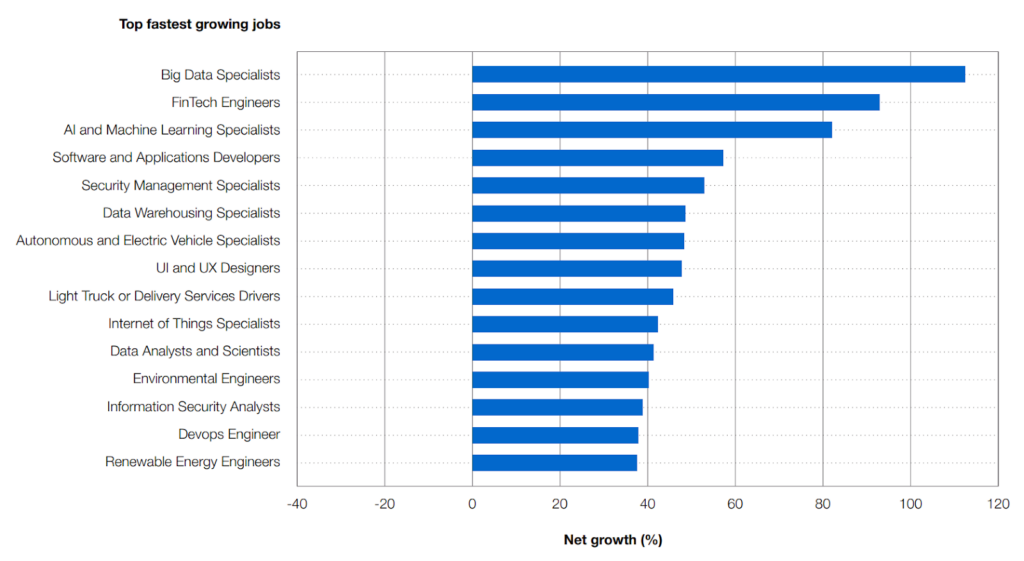
Fastest-growing jobs (2025–2030), WEF 2025 Future of Jobs report 2
The Coursera Fast Track: Learn Job-Ready Skills in Under 12 Months
The same forces reshaping AI-resilient careers and in-demand jobs in 2025 are also redefining how people learn them. Coursera’s short, stackable programs reflect that shift toward practical, fast career training. Whether you go for MasterTrack programs developed with trusted universities or Coursera Professional Certificates built by industry leaders, you can prepare to pursue a new job in under a year and for a fraction of the cost of a traditional degree.13,14 In fact, many programs advertise completion times of 3 to 9 months when studied at a part-time pace of roughly 10 hours a week.
Affordability is a key part of the value proposition. Learners pay monthly rather than committing to full tuition upfront, meaning costs stop once the credential is earned, avoiding the multi-thousand-dollar price tag of a full bachelor’s or master’s degree. After a 7-day trial, the monthly cost of a Coursera Plus subscription is $49.15 If you commit to a full year, the cost is $399, with a 14-day money-back guarantee, which works out to only $33.25 per month. While you have an active subscription, you can enroll in multiple courses simultaneously. This means that, if time isn’t an issue, you can learn more and earn more credentials for the same price.
Valuable content aside, Coursera also supports job-seeking outcomes via its Career Academy, where you can explore over 50 beginner roles, as well as several intermediate and advanced ones.16 You can also access career resources detailing skills and career path planning, and explore success stories from learners like you who used Coursera Professional Certificates to kick-start or switch up their AI-resilient careers.
For a comprehensive list of tips and strategies for each stage of your career, head to their Job Search Guide, where you can choose a career path and walk through jobs that fit your lifestyle, including jobs you can get without a degree. You can also find information on how to change careers or upskill for your next role, including resume and interview prep.17
Spotlight: Coursera Certificates for the Fastest-Growing Roles
Now that we’ve covered how Coursera’s fast career training model aligns with shifting job market demands, let’s explore how that alignment plays out in actual programs. Below are several Coursera Professional Certificates mapped to four of the sectors previously identified as growing for AI-resilient careers, each with its approximate duration and entry requirements.
Data and AI Careers
From business analytics to machine learning, the rise of data-driven decision-making has reshaped what employers look for, and what Coursera now teaches, with help from giants like Google, IBM, and Amazon.
| Program | Offered by | Approximate Duration | Entry Requirements | Key Topics |
| Google Data Analytics Professional Certificate18 | 6 months at 10 hrs/week | – Beginner level – No degree or prior experience required | Data analysis, SQL, Tableau, R programming, AI skills | |
| IBM Data Analyst Professional Certificate19 | IBM | 4 months at 10 hrs/week | – Beginner level – No degree or prior experience required – Basic computer literacy and high school math | Data analysis, Python, Microsoft Excel, IBM Cognos Analytics, SQL, GenAI |
| AI for Everyone20 | DeepLearning.AI | 5-6 hours to complete | – Beginner level – No prior experience required | AI concepts, terminology, workflows, societal impact, ethics |
| Generative AI with LLMs21 | AWS & DeepLearning.AI | 3 weeks at 5-6 hrs/week | – Intermediate level – Some experience coding in Python | LLM training and fine-tuning, prompt engineering, reinforcement learning from human feedback (RLHF) |
Cyber Security Careers
As technology expands into every part of life, the need for cyber security professionals continues to grow. For beginners eager to build a foundation in digital security, Coursera offers several accessible starting points for fast career training.
| Program | Offered by | Approximate Duration | Entry Requirements | Key Topics |
| Google Cybersecurity Professional Certificate22 | 6 months at 7 hrs/week | – Beginner level – No prior experience required | Linux, SQL, network protocols, threat detection, Python, AI skills | |
| IBM Cybersecurity Analyst Professional Certificate23 | IBM | 4 months at 10 hrs/week | – Beginner level – No degree or prior experience required – Comfortable working with computers | Network protocols, operating systems, SQL, threat detection, compliance, penetration testing, incident response, GenAI |
| Microsoft Cybersecurity Analyst Professional Certificate24 | Microsoft | 6 months at 10 hrs/week | – Beginner level – No prior experience required | Cloud computing, threat management, Azure Active Directory, Microsoft Defender, Microsoft SC-900 Exam prep |
Note: The Coursera job-ready certificates in cyber security from Google and IBM can be recognized for credit if you are admitted and enroll in one of the eligible degree programs, such as Bachelor of Information Technology at Illinois Tech or Bachelor of Applied Arts and Sciences at the University of North Texas.
Healthcare and Health Tech Careers
As healthcare systems continue to grow rapidly and become more data-driven, Coursera’s health-tech credentials help learners step into that transformation.
| Program | Offered by | Approximate Duration | Entry Requirements | Key Topics |
|---|---|---|---|---|
| AI in Healthcare Specialization25 | Stanford University | 4 weeks at 10 hrs/week | – Beginner level – No prior experience required | Clinical data management, machine learning for healthcare |
| Health Informatics Specialization26 | Johns Hopkins University | 4 weeks at 10 hrs/week | – Beginner level – No prerequisites, but prior experience with, or knowledge of, health, healthcare, or technology is helpful | Health information management, decision support systems, data science |
Careers in Business and Leadership
Technology might power modern workplaces, but it’s leadership that keeps them running. That’s why Coursera’s business and project management programs focus on the human side of work that software can’t replicate, leading to AI-resilient careers revolving around team management and planning.
| Program | Offered by | Approximate Duration | Entry Requirements | Key Topics |
| Google Project Management Professional Certificate27 | 6 months at 10 hrs/week | – Beginner level – No degree or prior experience required | Project management, risk management, team management, Agile methodology, AI skills | |
| Wharton Business Foundations Specialization28 | University of Pennsylvania | 2 months at 10 hrs/week | – Beginner level – No prior experience required | Marketing, financial accounting, people management, corporate finance, operations management |
| Strategic Leadership and Management Specialization29 | University of Illinois Urbana-Champaign | 2 months at 10 hrs/week | – Beginner level – No prior experience required | Team leadership, organizational change, business and corporate strategy |
Note: If the specialization at the University of Illinois makes you want to learn more, know that Coursera also partners with them for a graduate certificate in Strategic Leadership and Management.30 It costs a little over $4,000, consists of three courses, and stacks directly into the full Master of Business Administration (iMBA), Master of Science in Accountancy (iMSA), and Master of Science in Management (iMSM) from the University of Illinois.31
Why These Roles Are More AI-Resilient
In-demand jobs in 2025 in data, cyber security, healthcare, and leadership all have in common something automation can’t replace: human judgment and strategic thinking. Research from the World Economic Forum and McKinsey shows that roles combining technical fluency with human-centered decision-making are expanding fastest.2,3 These “hybrid” jobs pair AI tools with skills like empathy and ethics, qualities that keep complex systems running safely and responsibly.
Coursera’s programs mirror this reality. Aside from mastering technical skills such as data analysis or network security, learners also practice teamwork and problem-solving through projects and simulations. And it’s this blend of adaptive and technical abilities that makes Coursera graduates well-prepared for AI-resilient careers in the rapidly evolving workplace.
Getting Started: Your One-Year Career Roadmap
Your path to a new career in one of the best jobs for the future can begin today, with something as easy as a clear starting point.

"Career Karma entered my life when I needed it most and quickly helped me match with a bootcamp. Two months after graduating, I found my dream job that aligned with my values and goals in life!"
Venus, Software Engineer at Rockbot
Step 1: Identify a career path.
Use Coursera’s Career Academy as a guide to find in-demand roles that match your interests, background, and goals.
Step 2: Enroll in a Professional Certificate.
Choose a program aligned with your field and commit to a consistent study routine. You only need to set aside a few hours a week.
Step 3: Build your portfolio.
Complete the projects and hands-on labs included in each course to gain real, job-ready skills.
Step 4: Launch or advance your career.
Tap into Coursera’s career advice to find your next job and prep for the interview. Depending on the certificate, you may also stack it into a MasterTrack or a degree to keep moving forward.
Now You Know How To Train for AI-Proof Careers With Coursera Certificates
A four-year degree is no longer the only route to a meaningful career. With Coursera, you can build job-ready skills in under a year, at a fraction of the cost, and step directly into growing fields that value adaptability and real-world experience.
The future belongs to those who keep learning. Coursera gives you the tools to do it your way, without the cost or time of a full degree, so you can keep up with a world that never stands still.
Sources:
2 https://reports.weforum.org/docs/WEF_Future_of_Jobs_Report_2025.pdf
4 https://www.bls.gov/opub/mlr/2024/article/a-new-data-product-for-occupational-skills.htm
5 https://www.hbs.edu/managing-the-future-of-work/Documents/research/Skills-Based%20Hiring.pdf
6 https://www.bls.gov/ooh/computer-and-information-technology/software-developers.htm#tab-6
7 https://www.comptia.org/en-us/resources/research/state-of-the-tech-workforce-2025/
8 https://www.bls.gov/ooh/computer-and-information-technology/information-security-analysts.htm#tab-6
9 https://www.comptia.org/en-us/resources/research/state-of-cybersecurity/
11 https://www.bls.gov/ooh/business-and-financial/management-analysts.htm#tab-6
12 https://www.bls.gov/ooh/business-and-financial/project-management-specialists.htm#tab-6
13 https://www.coursera.org/mastertrack
14 https://www.coursera.org/professional-certificates
15 https://www.coursera.org/courseraplus
16 https://www.coursera.org/career-academy
17 https://www.coursera.org/articles/job-search-guide-resources
18 https://www.coursera.org/professional-certificates/google-data-analytics/
19 https://www.coursera.org/professional-certificates/ibm-data-analyst
20 https://www.coursera.org/learn/ai-for-everyone
21 https://www.coursera.org/learn/generative-ai-with-llms
22 https://www.coursera.org/professional-certificates/google-cybersecurity
23 https://www.coursera.org/professional-certificates/ibm-cybersecurity-analyst/
24 https://www.coursera.org/professional-certificates/microsoft-cybersecurity-analyst
25 https://www.coursera.org/specializations/ai-healthcare/
26 https://www.coursera.org/specializations/health-informatics
27 https://www.coursera.org/professional-certificates/google-project-management
28 https://www.coursera.org/specializations/wharton-business-foundations
29 https://www.coursera.org/specializations/strategic-leadership
30 https://www.coursera.org/certificates/graduate-certificate-strategic-leadership-management-illinois
About us: Career Karma is a platform designed to help job seekers find, research, and connect with job training programs to advance their careers. Learn about the CK publication.